
Reputation
Negative press, litigation, management turnover
Banks and insurers
Intelligent risk analysis for banks and insurance companies based on large language models (LLMs). External signals are transformed into quantified risk features, compliant with EBA, CRR III, MaRisk and the EU Taxonomy.
Regulation
Output is auditable, documented and readily integrable.
Coverage
Negative press, litigation, management turnover
Environmental incidents, controversies, Tier-1/2 suppliers
Sanctions, licence violations, audit reports
Payment defaults, market losses, operational disruptions
Pipeline
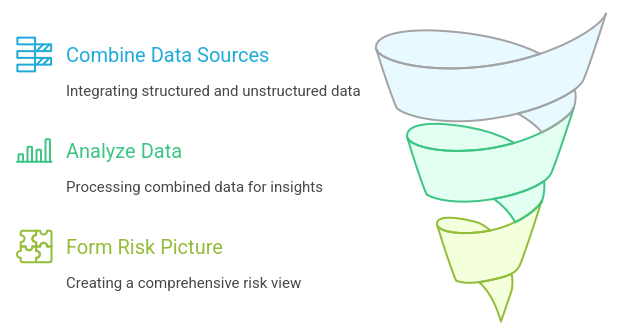
News, social media, reports and other open data sources.
LLM-powered analysis to identify relevant events and signals.
Assessment via scores, frequency, relevance and evidence documentation.
Delivery of structured features for Python, SQL, Databricks or SAS.
Comparison
Safeguards
Cost and latency. LLMs process complex volumes of text, so a proper balance between cost, response time and coverage is critical. Depending on the use case, processing occurs in batch mode or near real-time, combining timeliness with cost-efficiency.
Evaluation and quality assurance. Since no predefined labels exist, sample datasets ("gold sets") are used to regularly verify relevance and precision. Additionally, manual spot checks and source comparison ensure consistency over time and detect drift.
Hallucination and misinterpretation. Every derived statement carries source references and evidence texts, keeping the decision traceable. This allows verification of why a risk was identified and whether the underlying basis is valid.
Governance and traceability. Every analysis is versioned, logged and reproducible. Prompts used, models deployed and timestamps are archived so results remain auditable and traceable, compliant with internal control systems and regulatory requirements.
LLM-based systems provide high transparency, but also bring unique challenges that must be actively managed.
Live demo with your sectors and counterparties. Quick start via data feed, with optional in-house setup and consulting.
Request a demoContact
A short message is enough. We reply within one working day, with a real assessment rather than a sales pitch.